

Our agenda at COP30: scaling up funding for feminist locally led adaptation
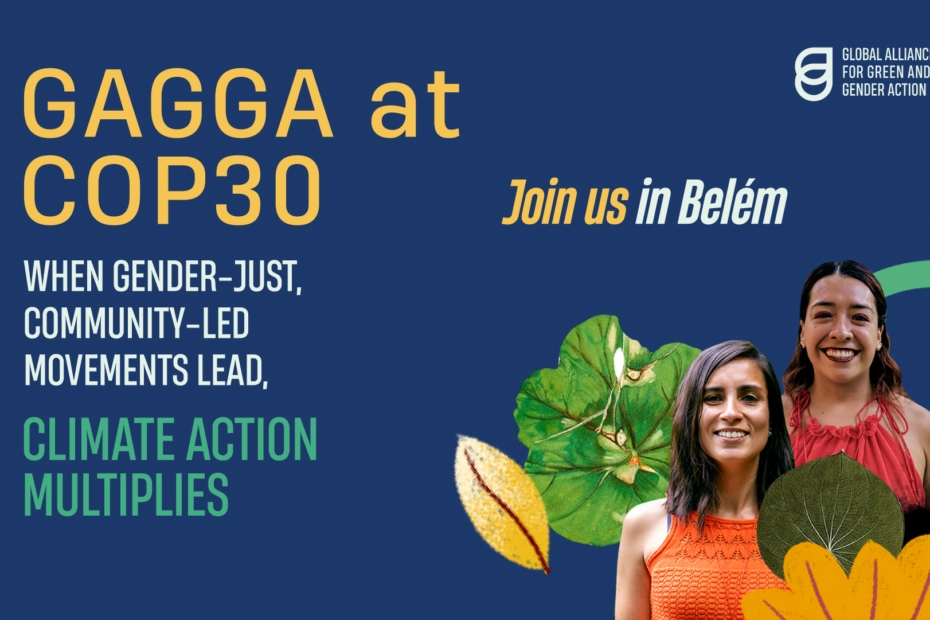
As the world prepares to gather in Belem next week for COP30, climate leaders have a critical opportunity to unlock the transformative potential of climate finance. The current narrow focus on mitigation must shift towards supporting rights-based, locally led and justice-centred climate action. Critical to this shift is recognising that women’s funds and feminist movements – especially those rooted in the Global South – are essential actors for climate adaptation that is locally led, equitable, and sustainable.
From regime to reality: COP30’s mandate, and what’s still missing
Since the inception of the UN climate regime, adaptation has generated ever-growing commitments on providing finance, technology, and capacity to lower income, less climate resilient countries. At COP30, global leaders will discuss building on the global goal on adaptation as the target set in 2021 at COP26 is due to expire. This is an important opportunity to scale up adaptation finance and address the ongoing disparity between mitigation and adaptation funding. Meanwhile, the details of broader climate finance commitments will be revealed: at COP29 in Azerbaijan in 2024, nations set the new collective quantified goal (NCQG) tripling the long held $100bn annual target to $300bn per year. Eventually, the goal is to reach $1.3 trillion annually by 2035. This, however, was met with disappointment from civil society and countries in the Global South who are calling for a specific adaptation target under the NCQG. The Baku to Belem Roadmap, set to drop this week, calls on all actors to work toward mobilizing $1.3 trillion annually in international climate finance by 2035.
Yet the gap between adaptation finance needs and flows remains significant and it’s not only a question of quantity but quality. The majority of adaptation finance is delivered in the form of loans to developing countries – with least developed countries and small island developing states receiving grants-based finance. This reinforces regional inequalities and colonial legacies by increasing the burden of debt on countries already disproportionately affected by climate change. Adaptation grants too often fail to reach the women, girls, and marginalized groups facing the worst climate impacts – just 2.3% of adaptation finance targets gender equality and from 2017-2021, only 17% of adaptation finance reached the local level.
For Mama Cash and our partners in the feminist funding ecosystem, COP30 is a moment to highlight the critical importance of directing adaptation finance to the women and girls on the frontlines of the climate crisis. Policymakers must recognise the critical role of women’s and feminist funds as effective intermediaries to advance adaptation that is rooted in women’s leadership and community power. As they seek to scale up and unlock new sources for adaptation finance, we need coordinated efforts from multilateral, bilateral and philanthropic climate actors, including the Adaptation Fund, to drive just and accessible finance to the local level.

What is a gender-just approach to locally led adaptation and why does it matter?
A gender-just approach to locally led adaptation strengthens climate resilience by:
- Supporting women and marginalized groups leading on adaptation strategies, centring their solutions and ingenuity.
- Shifting power and agency to community-level, centring participation of women and marginalized groups in climate governance and resisting the default model of vulnerable communities as passive beneficiaries of externally imposed projects.
- Valuing local and traditional knowledge alongside new technologies and innovations, generating contextually appropriate solutions.
- Tackling structural inequalities by explicitly integrating systemically excluded groups in adaptation design.
- Building sustainable institutional capacity so community-based systems outlast a single project.
Disproportionate vulnerability, overlooked leadership
Women, girls, and Indigenous peoples face disproportionate impacts from climate change – loss of water, crop failures, longer distances to fetch resources, and heightened food insecurity. However, they are often excluded from decision-making and access to climate finance.
Yet, when women lead, adaptation improves. Locally led organisations grounded in the priorities of women, girls and their communities often yield more sustainable, resilient outcomes—because they reflect situated expertise, indigenous know-how and intrinsic incentives.
Effectiveness, ownership, and justice
Locally led adaptation is more effective, because it addresses real, local vulnerabilities, and is more likely to be sustained in the long-term. It embeds ownership, reducing dependence on external actors. Crucially, it advances climate justice by placing decisions and resources in the hands of those most affected.
The pivotal role of feminist intermediary funders
Funders – especially women’s and feminist funds – play a pivotal role in advancing and resourcing locally-led adaptation. They do so by:
- Filling the void: connecting governments and global philanthropy to grassroots organisations that are too small or informal to meet conventional climate fund thresholds or compliance requirements.
- Investing in capacity, not just projects: strengthening governance, financial systems, adaptive skills, and strategic planning in local women-led organisations.
- Refining methodologies: developing metrics, accountability processes and learning pathways grounded in local realities and supportive of grantee-partner’s climate justice ambition.
- Advancing feminist climate leadership: acting as credible nodes in funding ecosystems, with deep roots in women’s rights and local networks.
One flagship model is the Global Alliance for Green and Gender Action (GAGGA) — formed by Mama Cash, Both ENDS, and FCAM — which has channelled over EUR 45 million to more than 2300 women-led, community-based organisations across 60 countries, since 2016. Crucially, GAGGA provides core, multi-year flexible grants, all the while working across its network and with grantee-partners on capacity strengthening and advocacy.
In practice: adaptation leadership worldwide
When trusted and resourced, women on the frontline of the climate crisis strengthen resilience and adaptive capacities in a way that is just, sustainable and transformative. Examples from our diverse network of Mama Cash and GAGGA partners demonstrate the strength and diversity of the women leading adaptation efforts globally:
- In Guatemala, ASOMTEVI is influencing national authorities to support the economic development of Indigenous and rural women in vulnerable situations, emphasising the importance of recognising in law their contributions and practices for adapting to the effects of climate change.
- In Malaysia, Klima Action Malaysia (KAMY) lobbies and contributes to government efforts to ensure that gender justice is central to climate governance, policies, national climate action budgets and decision-making processes.
- In Tajikistan, Bonuvoni Fardo campaigns for women to register their rights to family-owned or inherited lands, and use them for traditional, sustainable farming practices. In 2024, more than 150 women received registration certificates.
- The Mukonka village in Zambia faced severe deforestation due to illegal logging and charcoal production, leading to loss of streams, forests, and traditional food sources. Through Women Environs Zambia, the women of Mukonka, led the restoration of their land and rebuilding of livelihoods and food security by reviving indigenous seeds and practicing agroecology. Through joint advocacy with activists, Indigenous communities, and environmental groups, they secured land rights and contributed to the government’s decision to ban illegal logging.
- In Fiji, Soqosoqo Vakamarama iTaukei Ba (SVTB, Women in Action) ensures Indigenous women lead critical adaptation interventions, including riverbank stabilization, coastal reclamation, and reforestation.

Call to action
To align with locally led adaptation goals, those funding climate action and adaptation must re-shape their approaches:
- Prioritize feminist funds and women’s funds: fund organisations that are rooted in local realities and centered on women’s leadership.
- Provide flexible, multi-year funding: avoid tight project cycles and rigid deliverables. Let local leaders set objectives, timelines, and pivots as conditions evolve.
- Embed inclusivity and structural justice: design evaluation criteria, budgets, and governance systems to explicitly account for gender, disability, caste, race, and power dynamics.
- Co-create and democratize accountability: partners should help define feminist-informed metrics and ensure reciprocal accountability, rather than imposing one-size-fits-all indicators.
- Scale through networks: encourage peer learning, replication and expansion of successful models, without subsuming them in centralized control.
COP30: women as changemakers
As COP30 approaches, we urge climate finance actors, including governments, philanthropists, and multilateral organisations to take this bold step: invest in feminist funders and gender-just approaches to locally led adaptation. The most effective, just, and sustainable adaptation to climate change will emerge where power, agency, and funding converge—let us work together to move adaptation finance into the hands and minds of the feminist’s movements at the helm of climate action.